
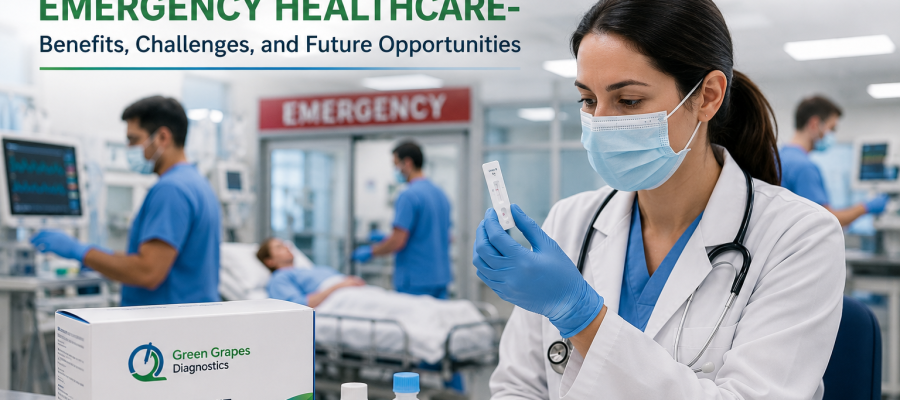
In emergency healthcare situations, every second matters. Whether dealing with infectious disease outbreaks, trauma cases, cardiac emergencies, or critical care patients, healthcare professionals need fast and reliable diagnostic information to make timely treatment decisions. This is where rapid testing has transformed modern healthcare.
Rapid diagnostic technologies enable healthcare providers to identify medical conditions within minutes rather than hours or days, improving patient outcomes and supporting efficient healthcare delivery. As a trusted provider of diagnostic solutions, Green Grapes Diagnostics continues to support hospitals, laboratories, and healthcare facilities with high-quality rapid testing products designed for today’s evolving healthcare needs.
What is Rapid Testing in Emergency Healthcare?
Rapid testing refers to diagnostic tests that provide results quickly, often within 10 to 30 minutes. Unlike traditional laboratory testing methods that may require specialized equipment and longer processing times, rapid tests are designed for speed, accessibility, and ease of use.
These tests are commonly used for:
- Infectious disease detection
- Emergency room diagnostics
- Point-of-care testing (POCT)
- Patient screening programs
- Critical care monitoring
The ability to obtain immediate results allows healthcare professionals to begin treatment faster and improve patient management.
Benefits of Rapid Testing in Emergency Healthcare
1. Faster Clinical Decision-Making
One of the biggest advantages of rapid testing is speed. Physicians and emergency teams can quickly diagnose conditions and initiate treatment without waiting for laboratory confirmation.
Faster decisions often lead to better patient outcomes and reduced complications.
2. Improved Patient Care
Timely diagnosis allows healthcare providers to prioritize critical patients and provide immediate medical intervention when necessary.
This improves patient satisfaction and enhances the overall quality of care.
3. Reduced Hospital Burden
Rapid testing helps reduce overcrowding in emergency departments by shortening patient waiting times and improving patient flow.
Hospitals can serve more patients efficiently while optimizing resources.
4. Better Infection Control
In cases involving infectious diseases, rapid diagnosis enables healthcare facilities to isolate affected patients quickly and reduce transmission risks.
This is particularly important during outbreaks and public health emergencies.
5. Increased Accessibility
Rapid testing solutions can be deployed in hospitals, clinics, ambulances, rural healthcare centers, and temporary medical facilities, improving healthcare accessibility in underserved areas.
Challenges Associated with Rapid Testing
While rapid testing offers significant advantages, healthcare providers should also understand its limitations.
Accuracy Considerations
Some rapid tests may have lower sensitivity compared to advanced molecular diagnostic methods such as RT-PCR testing.
Healthcare professionals often use confirmatory testing for certain clinical conditions.
Limited Testing Scope
Not every medical condition can be diagnosed using rapid tests alone. Complex diseases may require additional laboratory analysis.
Supply Chain Management
Healthcare systems must ensure a reliable supply of testing kits to avoid disruptions during periods of increased demand.
Training Requirements
Although many rapid tests are simple to use, healthcare workers still require proper training to ensure accurate sample collection and result interpretation.
The Future of Rapid Testing in Healthcare
The future of rapid diagnostics looks extremely promising. Technological advancements are making rapid tests more accurate, affordable, and widely accessible.
Artificial Intelligence Integration
AI-powered diagnostic tools are expected to improve result interpretation and reduce human error.
Expansion of Point-of-Care Testing
Healthcare providers are increasingly adopting point-of-care testing solutions that allow diagnostics to be performed closer to patients.
Digital Connectivity
Future rapid testing devices may integrate directly with electronic health records, improving reporting and patient monitoring.
Personalized Healthcare
Rapid diagnostics will play a major role in personalized medicine by supporting treatment decisions based on individual patient data.
Home-Based Diagnostics
The healthcare industry is witnessing growing demand for home diagnostic solutions that provide convenience and faster healthcare access.
How Green Grapes Diagnostics Supports Emergency Healthcare
Green Grapes Diagnostics understands the critical importance of speed and accuracy in emergency healthcare environments.
The company provides high-quality diagnostic solutions designed to support:
- Hospitals
- Emergency departments
- Diagnostic laboratories
- Healthcare distributors
- Public health organizations
With a strong focus on quality and reliability, Green Grapes Diagnostics helps healthcare professionals deliver faster diagnoses and better patient outcomes.
Its portfolio includes advanced diagnostic products that meet international healthcare standards and support modern medical practices worldwide.
Why Healthcare Providers Trust Rapid Testing Solutions
Healthcare organizations increasingly rely on rapid diagnostics because they offer:
- Faster turnaround times
- Improved patient management
- Better operational efficiency
- Enhanced disease surveillance
- Support for emergency response systems
As healthcare demands continue to grow, rapid testing will become an even more important component of modern healthcare infrastructure.
Conclusion
Rapid testing has revolutionized emergency healthcare by enabling faster diagnoses, improving patient outcomes, and supporting better clinical decision-making. While challenges such as accuracy limitations and supply management remain, ongoing innovation continues to strengthen the role of rapid diagnostics in healthcare.
As the industry moves toward more accessible and patient-centered care, Green Grapes Diagnostics remains committed to delivering reliable diagnostic solutions that support hospitals, laboratories, and healthcare providers around the world.
Frequently Asked Questions (FAQs)
1. What is rapid testing in healthcare?
Rapid testing refers to diagnostic methods that provide results within minutes, helping healthcare providers make quicker treatment decisions.
2. How long do rapid tests usually take?
Most rapid diagnostic tests provide results within 10 to 30 minutes.
3. Are rapid tests as accurate as RT-PCR tests?
Rapid tests are highly useful for screening and emergency care, while RT-PCR tests generally offer higher sensitivity and accuracy for certain conditions.
4. Where are rapid tests commonly used?
Rapid tests are widely used in hospitals, emergency rooms, clinics, ambulances, and point-of-care healthcare settings.
5. Why choose Green Grapes Diagnostics for rapid testing solutions?
Green Grapes Diagnostics provides reliable, high-quality diagnostic products that support faster diagnosis and improved patient care.