

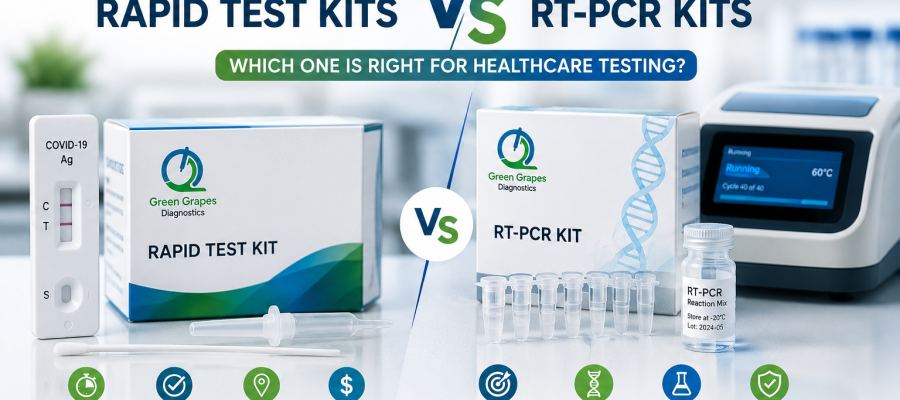
Accurate and timely diagnosis is the foundation of effective healthcare. Hospitals, laboratories, and healthcare professionals rely on advanced diagnostic methods to detect diseases, monitor infections, and guide treatment decisions. Among the most commonly used testing methods today are Rapid Test Kits and RT-PCR Kits.
Both technologies play an important role in healthcare, but understanding their differences helps medical professionals choose the right solution for specific testing requirements. As a trusted diagnostic solutions provider, Green Grapes Diagnostics offers high-quality testing products that support accurate and efficient healthcare services.
What Are Rapid Test Kits?
Rapid Test Kits are diagnostic tools designed to deliver results within a short period, usually within a few minutes. These tests are easy to use and often require minimal laboratory infrastructure.
Rapid tests are commonly used for:
- Infectious disease screening
- Pregnancy testing
- Antigen testing
- Point-of-care diagnostics
- Emergency healthcare situations
Their biggest advantage is speed, allowing healthcare professionals to make quick decisions regarding patient care.
What Are RT-PCR Kits?
RT-PCR (Reverse Transcription Polymerase Chain Reaction) is a molecular testing method used to detect genetic material from viruses or pathogens. RT-PCR testing is widely regarded as one of the most accurate diagnostic methods available.
RT-PCR Kits are commonly used for:
- Viral infection detection
- Molecular diagnostics
- Laboratory testing
- Disease confirmation
- Public health surveillance
Because of their high sensitivity, RT-PCR tests are considered the gold standard for many infectious diseases.
Rapid Test Kits vs RT-PCR Kits: Key Differences
| Feature | Rapid Test Kits | RT-PCR Kits |
| Result Time | 10–30 minutes | Several hours |
| Accuracy | Moderate to High | Very High |
| Testing Location | Clinics, hospitals, field testing | Laboratories |
| Equipment Needed | Minimal | Advanced laboratory equipment |
| Cost | Lower | Higher |
| Ease of Use | Simple | Requires trained professionals |
| Turnaround Time | Fast | Longer |
Both testing methods have their own advantages depending on the healthcare situation.
When Are Rapid Test Kits the Right Choice?
Rapid Test Kits are ideal when speed and accessibility are critical.
Emergency Screening
Healthcare providers often require immediate results to make quick decisions. Rapid tests help identify conditions quickly.
Remote Healthcare Facilities
Clinics in rural or underserved areas may not have access to advanced laboratories. Rapid testing allows healthcare providers to perform diagnostics at the point of care.
Large-Scale Screening Programs
Rapid tests are frequently used during mass screening campaigns because they provide results quickly and efficiently.
When Are RT-PCR Kits the Better Option?
RT-PCR testing is preferred when maximum accuracy is required.
Disease Confirmation
RT-PCR is commonly used to confirm infections and provide highly reliable results.
Laboratory-Based Testing
Advanced laboratories equipped with specialized equipment can perform RT-PCR testing with high precision.
Public Health Monitoring
Government healthcare agencies often use RT-PCR testing for disease surveillance and outbreak management.
Benefits of Rapid Test Kits
- Faster results
- Cost-effective testing
- Easy to perform
- Minimal equipment requirements
- Suitable for point-of-care testing
- Improves patient management speed
Benefits of RT-PCR Kits
- Highly accurate results
- Excellent sensitivity
- Reliable disease confirmation
- Suitable for complex diagnoses
- Supports advanced molecular testing
- Trusted by healthcare professionals worldwide
How Green Grapes Diagnostics Supports Healthcare Providers
Green Grapes Diagnostics provides reliable diagnostic solutions that meet international quality standards. The company offers both rapid testing and molecular diagnostic solutions to support healthcare facilities, laboratories, and medical distributors.
Healthcare providers trust Green Grapes Diagnostics because of:
- High-quality diagnostic products
- Reliable supply chain support
- International quality standards
- Customer-focused service
- Consistent product availability
By offering dependable testing solutions, the company helps healthcare professionals improve diagnostic accuracy and patient care.
Which One Should You Choose?
The choice between Rapid Test Kits and RT-PCR Kits depends on your healthcare requirements.
Choose Rapid Test Kits if you need:
- Immediate results
- Point-of-care testing
- Lower testing costs
- Large-scale screening
Choose RT-PCR Kits if you need:
- Maximum accuracy
- Laboratory confirmation
- Molecular diagnostics
- Advanced disease detection
In many healthcare settings, both testing methods work together to provide comprehensive diagnostic solutions.
Conclusion
Both Rapid Test Kits and RT-PCR Kits play an essential role in modern healthcare. Rapid tests offer speed and convenience, while RT-PCR testing delivers exceptional accuracy and reliability.
Healthcare providers should select the appropriate testing method based on clinical requirements, available resources, and patient needs. With its commitment to quality and innovation, Green Grapes Diagnostics continues to support healthcare organizations with trusted diagnostic solutions that improve healthcare outcomes worldwide.
FAQs
1. Which is more accurate: Rapid Test Kits or RT-PCR Kits?
RT-PCR Kits generally provide higher accuracy and sensitivity compared to Rapid Test Kits.
2. How long does a Rapid Test Kit take?
Most Rapid Test Kits provide results within 10 to 30 minutes.
3. Why is RT-PCR considered the gold standard?
RT-PCR detects genetic material with high accuracy, making it highly reliable for disease diagnosis.
4. Can Rapid Test Kits replace RT-PCR testing?
Rapid tests are useful for screening, but RT-PCR is often used for confirmation and detailed diagnosis.
5. Why choose Green Grapes Diagnostics?
Green Grapes Diagnostics offers reliable, high-quality diagnostic solutions trusted by healthcare providers, laboratories, and medical institutions.